
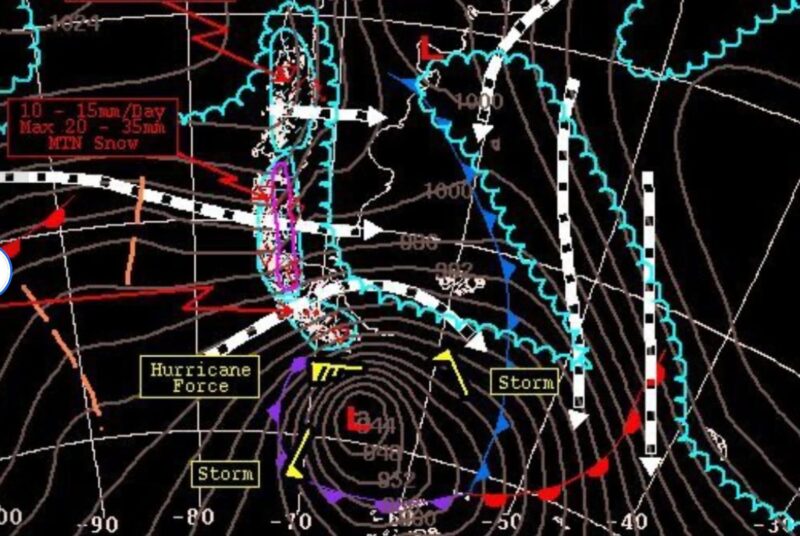
Between January 12 and 13, an intense explosive cyclone (or bomb cyclone, as it is popularly known), is expected to hit Tierra del Fuego, the Falkland Islands, the Drake Passage and the northern area of the Antarctic Peninsula. There is a possibility that sustained winds of 65 kt will hit mainly the northern sector of the Drake Passage, in which case the cyclone would be classified as an Antarctic Hurricane (see definition below). However, it is worth noting that gusts could reach 75 kt or even 80 kt.
In addition to the strong winds, there is expected to be snowfall, severe visibility restrictions and waves of up to 10 meters in the Drake, in addition to a sharp drop in atmospheric pressure of up to 40 hpa in 24 hours. The low pressure center is expected to hit Elephant Island with 945 hpa on the morning of the 13th.
Extratropical cyclones are common in this region of the globe, but those in the Explosive category are relatively rare in January. In 40 years of statistics, there have been only 8 records of explosive cyclones occurring in January, and these imminent cyclones could be the first to reach the Antarctic Hurricane category.
It is important to note that we are in the austral summer and during this period there is a significant increase in the traffic of research vessels, tourism vessels and aircraft between the south of South America and the Antarctic Peninsula. Therefore, air and maritime navigation services must be placed on alert due to the imminence of this intense meteorological system.
“Antarctic Hurricane” is defined herein as follows:
An extratropical cyclone will be classified as an Antarctic hurricane if it meets the following conditions:
a) Location: the extratropical cyclone must be located south of latitude 50ºS, that is, in the Antarctic Ocean or on the Antarctic coast/continent; b) Low pressure center: must be 1000 hPa or less;
c) Winds: the cyclone must have sustained winds ≥ 33 m/s, ≥ 74 mph, ≥ 119 km/h or ≥ 64 kt. Wind gusts will not be considered.
d) The 24-hour pressure drop must be at least 24 hPa, i.e. the cyclone must also be defined as an “Explosive Cyclone” according to the Bergeron rules.
Source: WEC